Types of Business Models
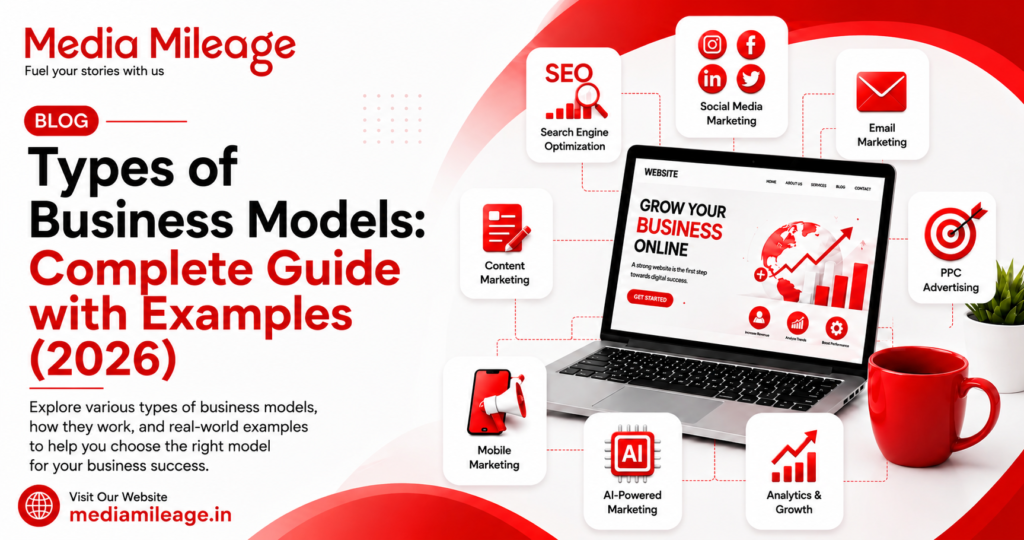
In the previous article, we discussed the benefits of using digital marketing in business. In this article, we will look at the various types of business models that companies can implement to grow and sustain their businesses.
A business model is a framework that explains how a business operates, delivers value to customers, and generates revenue. Having a clear business model is essential for building a sustainable and profitable business.
Key Types of Business Models
1. B2B (Business to Business)
In this business model, a company sells its products or services directly to another business.
Example: Software companies providing services to corporate organizations.
2. B2C (Business to Consumer)
In this model, businesses sell products or services directly to individual consumers. This is the most common and visible form of commerce.
Examples: Netflix, ZEE5
3. C2C (Consumer to Consumer)
This model allows consumers to sell products or services directly to other consumers, commonly seen in second-hand marketplaces.
Example: OLX
4. D2C (Direct to Consumer)
In this model, manufacturers sell products directly to consumers without involving wholesalers or retailers. This helps brands gain better control over branding, customer experience, and profit margins.
Examples: Mamaearth, boAt, Lenskart
5. Freemium Model
This model offers basic services for free while charging users for premium features or advanced services. It is commonly used in digital products and software platforms.
Examples: Canva, Gmail, Freepik
6. Marketplace Model
In this model, a platform connects buyers and sellers and earns revenue through commissions or transaction fees.
Examples: Amazon, Flipkart, Meesho
7. Aggregator Model
This model brings together services from multiple providers under a single platform while maintaining a unified customer experience.
Examples: Ola, Zomato, MakeMyTrip
8. Retail Model
In this model, businesses purchase goods from manufacturers or wholesalers and sell them directly to consumers.
Examples: Big Bazaar, Walmart
9. Franchise Model
Under this model, a business owner licenses their brand name, products, and operational system to another party in exchange for royalty fees.
Examples: Domino’s, Rose Milk Raja, We Crunch
10. Manufacturing Model
In this traditional model, businesses produce goods from raw materials and sell them to wholesalers, retailers, or directly to consumers.
Examples: Idhayam Oil, Chennai Gate Rice, Milky Mist
11. Dropshipping Model
In this model, sellers do not keep products in stock. Instead, when an order is placed, the seller purchases the product from a supplier who ships it directly to the customer.
Example: Drop Ship India
12. Ad-Based Model
This model generates revenue through advertisements shown to users or viewers. Businesses earn income based on traffic, engagement, or user base.
Examples: Google, Facebook, YouTube
13. Licensing Model
This model involves allowing others to use intellectual property such as software, patents, media content, or brand names in exchange for licensing fees or royalties.
Example: Microsoft
14. Razor and Blade Model
In this model, companies sell a primary product at a lower cost and generate recurring revenue through complementary products.
Examples: Gillette (razor + blades), Goodknight (machine + liquid refill)
15. Brokerage Model
This model acts as a middleman by connecting buyers and sellers and earning commissions or brokerage fees.
Examples: Zerodha, Angel One
Conclusion
Businesses have evolved from traditional operating methods to modern digital platforms, resulting in a wide variety of business models. Each model has its own strategy for generating revenue and delivering value to customers. Every entrepreneur should understand different business models to choose the right approach for their business growth and long-term success.
Frequently asked questions
What are the main types of business models?
Common models are B2B, B2C, D2C, C2C, marketplace, franchise, subscription, freemium, advertising-based and on-demand. Many businesses combine more than one.
What is the difference between B2C and D2C?
B2C brands may sell through retailers and marketplaces. D2C brands sell directly to customers through their own website or channels, keeping control of pricing, data and customer relationships.
Which business model is best for a startup?
It depends on the product and market. Subscription and SaaS models give recurring revenue, D2C gives control and margins, and marketplaces scale quickly but need both buyers and sellers.